About
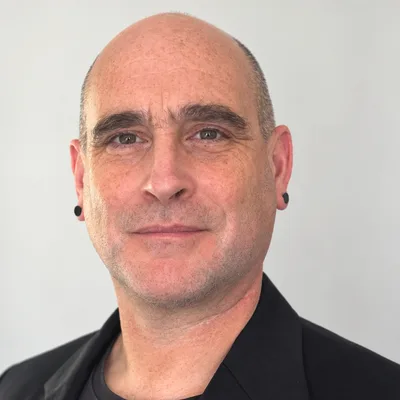
André Flitsch
I am the developer you talk to and the developer who does the work. There is nobody in between. This page tells you where that comes from and how I work, so you can judge it before we speak.

How I got here
Computers always interested me, though I read environmental biology, and the work I remember from it was software anyway. Everything I use professionally I taught myself, in the years before AI. That is why I rarely give up on somebody else's code: I never learned to expect a manual.
-
1996
Two questions with no software written for them
My honours project was a model built in Access that simulated how a disease might spread between trees in a London park. That same year I used GIS in Scotland to map possible habitats for reintroducing beavers, for a report to Scottish Natural Heritage. The reintroduction came years later; this report was part of the groundwork. Neither question had software written for it. I answered both with the tools that existed.
-
1998
The first shop
For Kinetec Records I built a browsable catalogue with filters and a cart. Ordering went through a secured form and a GPG-encrypted email.
-
1999
Independent
I have worked for myself since then, and e-commerce has been the focus ever since.
-
2001–2007
hot-zone.tv
osCommerce, the best thing available at the time and long before the large platforms. In the early 2000s it became one of the most successful independent snowboard shops in Europe.
-
2003–2007
TTR World Snowboard Tour
The TTR began in 2002, when the international snowboarding federation collapsed: a tour the riders ran themselves rather than a federation, with hundreds of events at different levels, Air & Style among them, and with the world ranking of snowboarding. The rankings lived in member pro, a membership system built for sport, and I wrote the code that carried the data into TYPO3, filterable by event, athlete, star level and discipline. That is the same work I do now. Two systems that know nothing about each other, and code in between turning their data into something a person can use. The systems just had different names.
-
2008
Magento, from the start
The year Magento 1.0 shipped, and the same year as my first shop on it, the fire-service shop for Empl in Fügen in the Zillertal. Many more on Magento 1 followed, and later the migrations to Magento 2.
-
2010
Pixel Perfect
I have run Pixel Perfect since then, from Itter in Tirol, Austria.
-
2019
Brentford Computers
A large Swiss computer retailer, on Magento 1 to begin with.
-
2020
The first Hyvä migration
In November, with the agency Diglin in Zürich. Hyvä was new then and there was little to build on.
What I work on
The core is e-commerce: Magento 1 and 2, Hyvä frontends, and the integrations between them and ERP, PIM and marketplace systems, including MGM, Akeneo and PlentyMarkets. Custom PHP with Symfony or Laravel when the problem sits outside the shop.
Not all of it is a shop. For VAMED Vitality World I built a system with a partner agency that let guests print their vouchers at home as a PDF. It ran for over five years. A shop is often only the visible part of the job.
Which service fits which problem is on the services overview. This page is not about what I offer. It is about who does it.
What I publish you can read without asking me: open-source Magento 2 modules, among them a Hyvä cookie-consent module that works under CSP strict mode. The modules and the reasoning behind them are in the blog, the code is on GitHub.
There is also work on the platform itself: contributions to the Magento core and to modules other people run, and membership of Mage-OS, the community fork of Magento Open Source.

No Translator in the Middle
A software project usually needs three roles. Someone to work out what is needed. Someone to organise it and hold it together. And someone to build it. Most of the time those are three different companies, and something is lost at every handover between them: a condition that was clear in the meeting and missing from the specification, an exception nobody thought mattered, a question that takes three weeks because it has to travel through three firms.
I am all three. I sit in the meeting with the people who will work with the system afterwards and find out what they actually need. People know their own problem precisely and can rarely describe software; translating between the two is the real work. From that I write the requirement. I bring in whoever else is needed and coordinate them. And then I build it myself.
What that means for you: the person who answers your question is the person who writes the code. Between what you said and what runs, there is nobody left.
How I work
I work as part of your team, not as an external supplier with a ticket system in between. In practice: you describe the problem, I look at it in the running system, and you get an assessment before anybody produces an estimate.
I say no when I am not the right person. It happens, usually when the task is design or marketing rather than engineering. Turning you down costs you a call. The wrong person on a project costs you a quarter.
I write down what I do. Handovers, decisions and the reasons for them go where your team will find them, including after I leave the project. That is not a courtesy. It is the condition under which one person can be accountable at all.
I work with agencies more often than against them. Diglin and Openstream in Switzerland, Head New Media, Studio Mitte in Austria and WilMa Digital in Germany. If you have an agency that does good work and needs a technical lead for Magento or an integration, that is the normal case and not the exception.
I have been going to Magento events since 2013. What is happening in the platform I hear there rather than in announcements.
Language and location
I work from Itter in Tirol, Austria, mostly remote, in a European timezone that overlaps a UK or EU working day in full. Distance has not been the constraint on any project I have run.
English is my first language, so the English side of this site is written rather than translated. You will not be working through one.
From projects
-

The integration layer for the multi-brand platform, along with shop data into the CRM and the company’s own warehouse into the shop.
-

Automated fulfilment for several brands from one warehouse, Bodylab24 and GymQueen among them.
-

Several brand shops under one roof, product data in Akeneo, the ERP connected, and the shop joined to the existing CMS over GraphQL. An ongoing partnership since 2016.
-
Brentford Computers
From 2019 on Magento 1, and in November 2020 my first Hyvä migration, with the Swiss agency Diglin.
Common questions
Who is André Flitsch?
I am an independent software and e-commerce developer in Itter in Tirol, Austria, and I have run Pixel Perfect since 2010. I have built software for over 30 years, in e-commerce since 1999 and with Magento since 2008. My work is shops, the integrations between shop, ERP and PIM, and automating the tasks that come back every week.
What happens if you are unavailable?
The honest answer is that one person is a risk, and that documentation is what shrinks that risk, not assurances. So every decision is written down inside your project, the code sits in your repository, and there are no credentials only I hold. Another developer can take over without reaching me.
Do you work with existing agencies and in-house teams?
Yes, and that is the more common case. Usually a team already exists and what is needed is a senior developer for Magento, integrations, performance or automation. I do not replace anyone who is working.
Let us find out whether I fit
30 minutes, no strings attached. Describe the task and I will tell you honestly whether I am the right person.